




At True Digitizing, we transform your creative spark into flawless, high-quality embroidery digitized designs that bring your vision to life.
Our Blogs
We Accept

Copyright 2025 Truedigitizing






At True Digitizing, we transform your creative spark into flawless, high-quality embroidery digitized designs that bring your vision to life.
We Accept
Copyright 2025 Truedigitizing
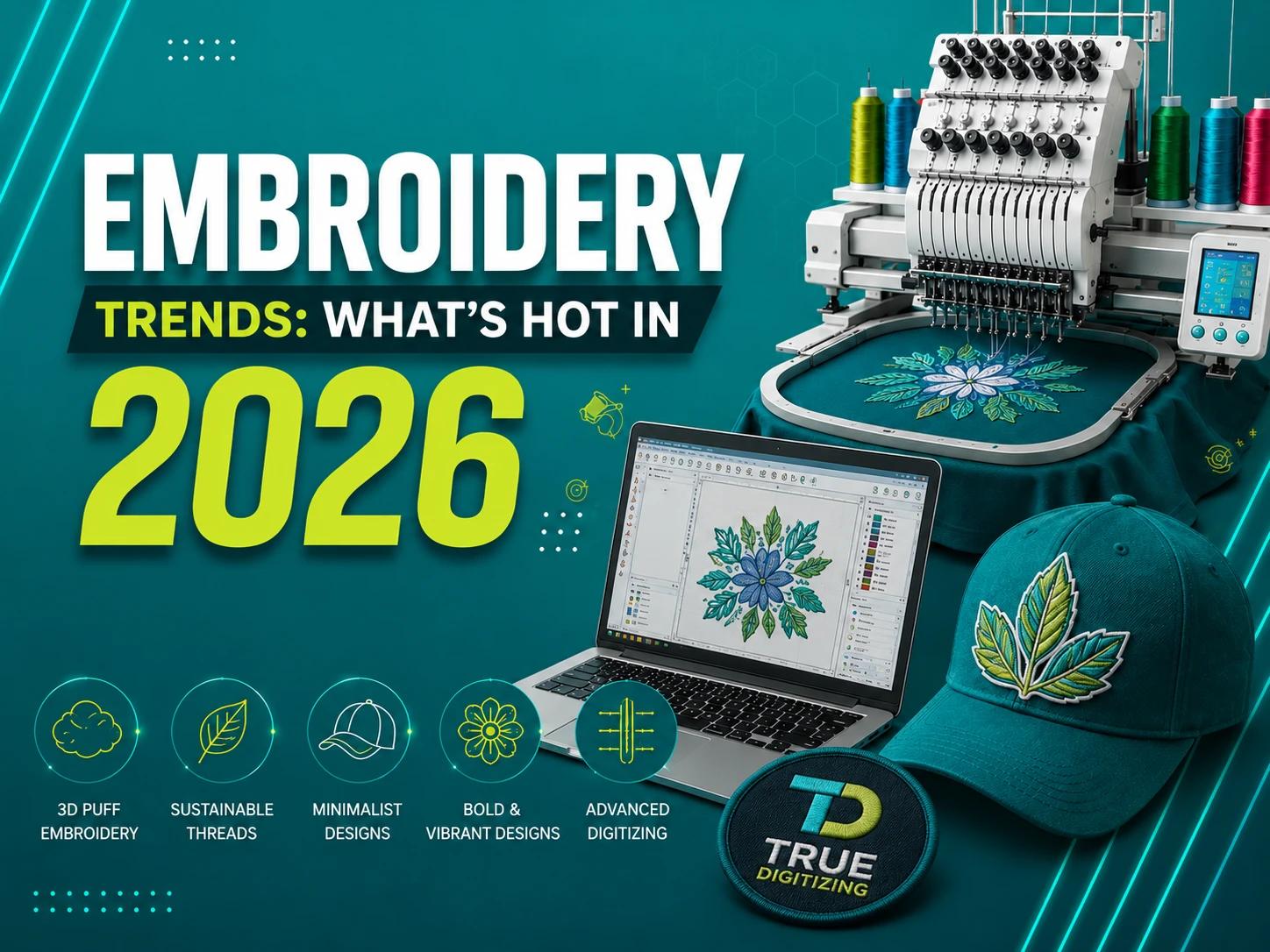


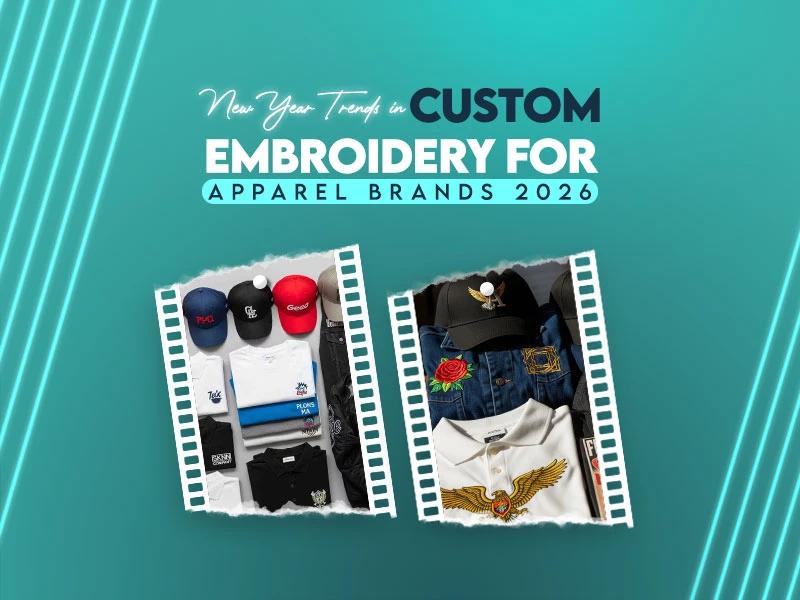
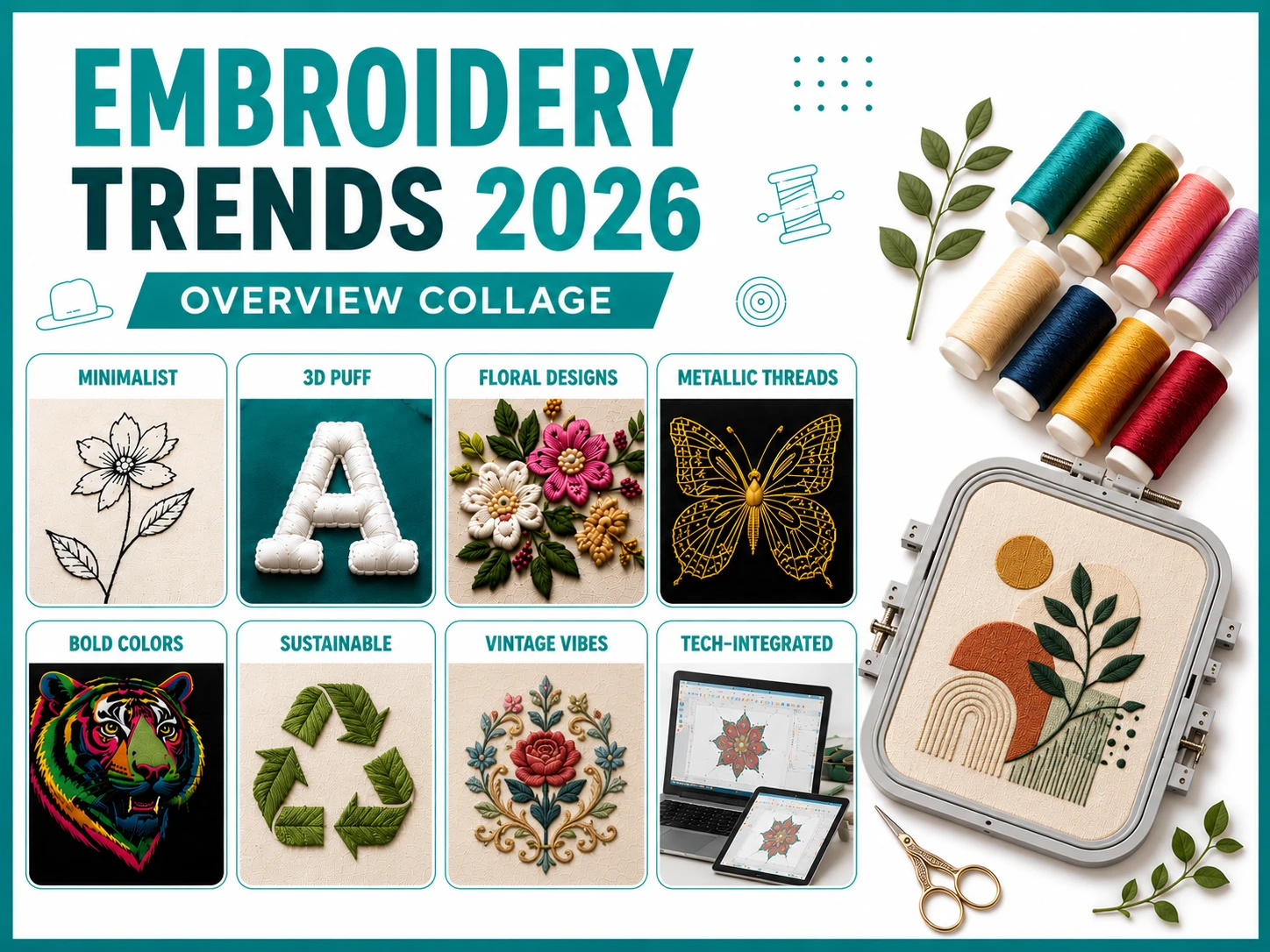
The biggest embroidery trends in 2026 are minimalist line art, oversized florals, 3D puff on structured hats, retro Y2K typography, metallic & iridescent thread, tone-on-tone micro embroidery, and appliqué mixed-media designs. Etsy's 2026 trend report calls it the "Soft Stitch Era" — a category-wide shift toward handcrafted texture and intentional, placement-driven design.
Something measurable has shifted in how people think about embroidery — and you can see it in the search data. Etsy's Spring/Summer 2026 Seller Trend Report identified what it calls the "Soft Stitch Era": a consumer-led return to handcrafted texture and visible craft. Searches for embroidered straw bags rose over 20,000% year-over-year on the platform. Beginner embroidery kits climbed 175%. Embroidered jeans searches are growing double digits every quarter. This isn't a niche resurgence — it's a category-wide shift in what buyers want from decorated apparel.
The broader market tells the same story. According to Cognitive Market Research (2025), the global embroidery market was valued at approximately $854.75 million in 2025 and is projected to reach $1.9 billion by 2033 — driven significantly by specialty techniques like 3D puff, appliqué, and mixed-media embroidery. At TrueDigitizing, we've digitized files across thousands of orders for brands ranging from independent streetwear labels to national uniform programs. What follows is grounded in direct production experience, validated against published research — not trend speculation.
Need a trending design digitized for your brand? Upload your artwork and get a production-ready stitch file within 24 hours — any style, any fabric.
Get Instant QuoteThree structural shifts define the current embroidery trend landscape:
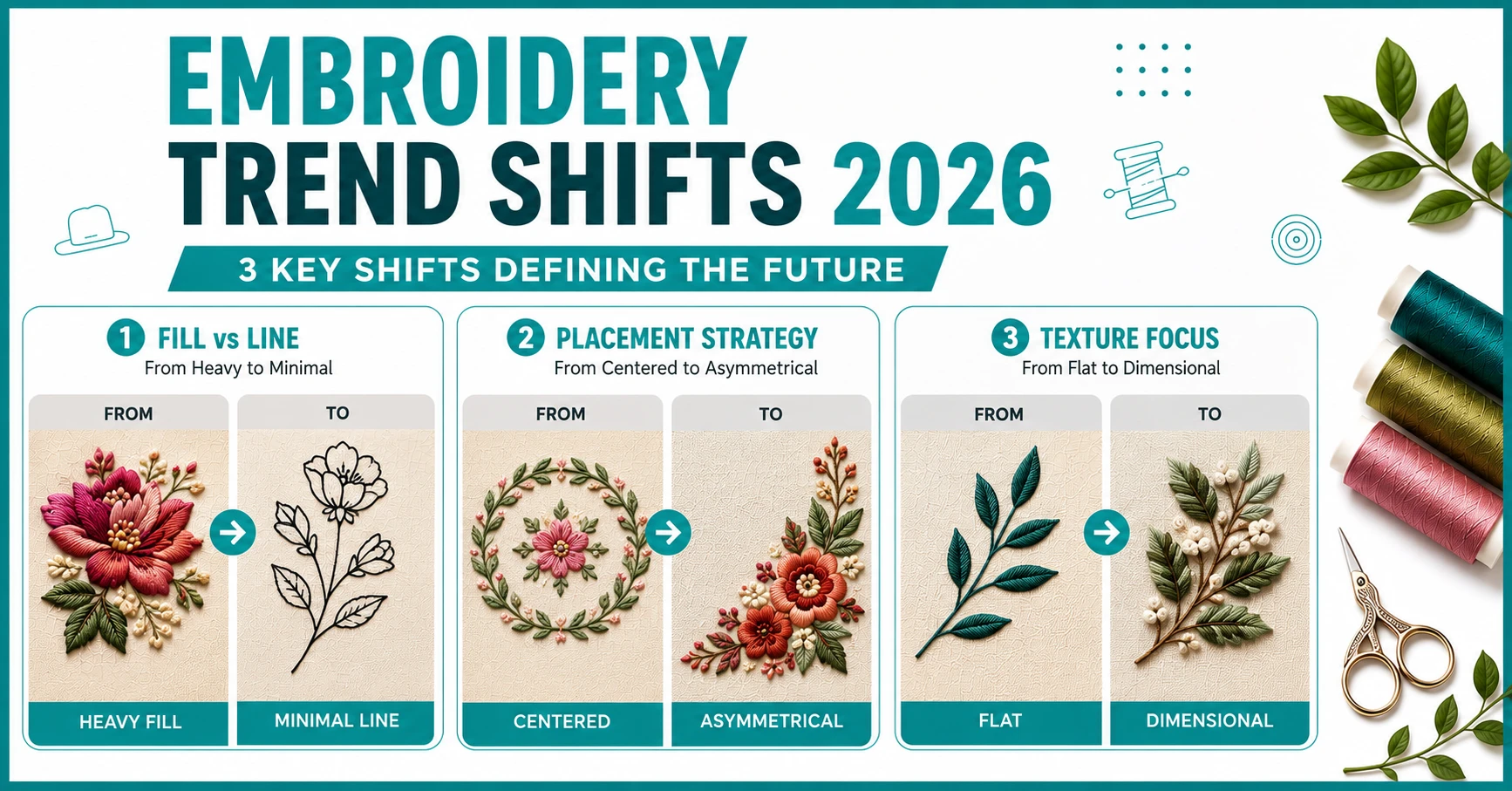
Fill is losing to line. Heavy satin-fill logos — dense, patch-like, high-stitch-count — are giving way to minimalist running-stitch outlines with open negative space. The aesthetic priority has flipped: restraint now signals quality more convincingly than coverage.
Placement has become strategy. Printful, which has fulfilled over 137 million items since 2013, reports that logo placement is now treated as a design decision equal in importance to the logo itself. Sleeve, collar, cuff, and back-of-neck placements are all outpacing standard left-chest positioning in new brand orders.
Texture is the differentiator. Much of the embroidery market's projected growth is being driven by demand for specialty techniques — 3D puff, appliqué layering, metallic thread — that deliver visual dimension flat embroidery cannot.
Below are the seven trends driving the most commercial production demand right now.
The single-thread movement — one continuous running stitch tracing a face, plant, or abstract form — has moved from indie craft circles into mainstream apparel branding. According to Etsy's 2026 trend data, this aesthetic is being driven specifically by Gen Z consumers rejecting mass-produced apparel in favor of designs that feel "intentional and personal."
The appeal for brands is restraint: a small botanical on a shirt cuff signals more intentionality than a large chest logo ever could. It's also efficient — lower stitch count means faster production runs on multi-head machines like the Tajima TMEZ-SC, which runs at up to 1,200 SPM and handles intricate single-thread paths reliably due to its i-TM automatic tension system.
Minimalist designs are technically deceptive. Because there's no fill coverage to hide imperfections, jump stitch placement, path routing, and stitch start/end points are all immediately visible in the finished sew-out. We regularly receive minimalist files auto-converted from JPEG sources where the path sequencing creates visible thread bridges across open areas — something that only appears in the physical piece, not in the software preview.
Best applications: Tote bags, linen shirts, sweatshirt pockets, hat side panels, jogger hip placement.
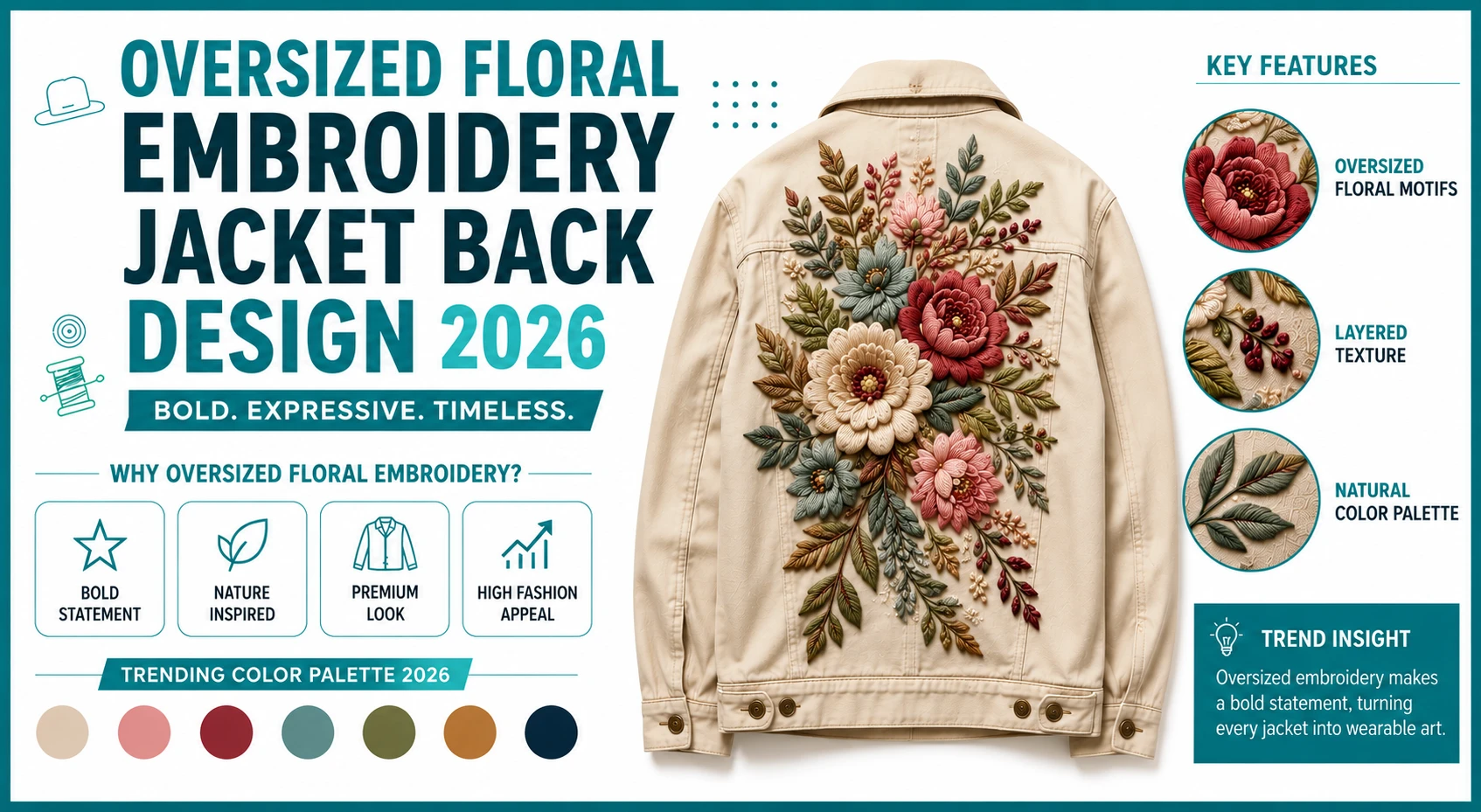
Printful's 2026 embroidery trend report explicitly identifies oversized floral embroidery as a standalone trend category, noting that large-scale botanicals now "transform everyday garments into premium statement pieces." Two opposing floral approaches are both performing strongly this year.
Oversized floral panels cover jacket backs, shirt fronts, or full denim legs using layered satin fills, multi-stop color sequences, and sometimes appliqué underlays. The design is the garment.
Minimalist floral outlines — single-stem roses, delicate wildflower clusters, or small botanical sprigs worked in stem or running stitch — are the daily-wear counterpart. One thin branch on a collar. A small daisy cluster at a pocket.
Digitizing note: For large-area floral fills, fabric selection directly affects quality. Dense fills on thin fabric cause puckering regardless of digitizing quality. Our guide to choosing the right fabric for embroidery covers which base materials handle high-density work reliably.
3D puff has been growing for several years. In 2026, it is fully mainstream — from independent streetwear labels to national corporate uniform programs.
The headwear market provides useful scale context: the global hats and caps market is forecast to grow from $28.21 billion in 2025 to $38.63 billion by 2031 at a 5.38% CAGR, according to Business Research Insights (2025). Customizable embroidered headwear is explicitly cited as a growth driver. 3D puff is the dominant decoration technique on structured caps.
Commercial machines purpose-built for high-volume hat work — such as the Brother PR1060W, Brother's 2026 flagship 10-needle machine with optical camera positioning and automatic hoop detection — have made puff embroidery on caps faster and more consistent for smaller production operations. Ricoma's Marquee 2 Series, which runs at 1,500 SPM with an independent presser foot that auto-adjusts for thick or layered materials, handles the added material thickness of puff foam without the tension issues older machines required manual calibration to manage.
Our dedicated 3D puff embroidery digitizing service covers standard puff, multi-layer puff, and hybrid puff/flat designs.
Y2K aesthetics have cycled through fashion for several years. What's changed in 2026 is that the embroidery interpretation is now commercially codified and reproducible at scale.
The hallmarks: chunky varsity letterforms, distressed serif fonts, bubbly 90s scripts, bold slogans in high-contrast color blocking. Short phrases over long text. Dual-thread combinations — red and cream, black and gold, navy and orange — that reinforce vintage palettes.
Digitizing requirements: Typography embroidery lives or dies on minimum letter height. For lowercase satin-stitch letters, 4mm is the minimum before letterforms lose definition. For column stitches on thick sans-serif letterforms, density control at the curves is critical — over-dense satin stitches at letter terminals create thread buildup that distorts the shape. At high production speeds on machines like the Melco SUMMIT, which runs at 1,500 SPM with Acti-Feed™ automatic thread tensioning, tight typography runs cleanly when the density is properly set — but accelerates distortion problems if it isn't.
Iridescent and oil-slick threads are replacing flat gold and silver metallics on premium garments in 2026. The driving factor is better thread engineering.
Madeira's Supertwist line is the most widely referenced product in this category — constructed of a specifically developed raw material that eliminates looping, puckering, and virtually all thread breaks. It's available in 121 colorways including 16 opal tones and 26 crystal colors and holds Oeko-Tex® certification. The recommended digitizing density is an average of 6.0 — approximately 20–30% lower than standard polyester settings — which reduces friction and prevents the breakage that made older metallic threads unreliable at commercial machine speeds.
The practical consequence: iridescent metallics are now viable for larger production runs, not just short-run or sample-level work. Where it appears: Premium branded headwear, fashion collaborations, embroidered patches, holiday merchandise, evening wear labels.
For background on how thread type affects stitch density and production settings across the full range of thread options, see our guide to common thread types in machine embroidery.
Tone-on-tone embroidery uses thread closely matched to the base fabric — navy on navy, cream on cream, black on black. The design is visible only in texture and light reflection, not color contrast. It's frequently specified by luxury brands, hotel and hospitality programs, and high-end uniform providers.
The digitizing challenge is density management. On matched-color work, any over-dense area creates a visible sheen difference that highlights the fill boundary against the surrounding fabric. Underlay choice becomes more critical than in standard color-contrast work — the foundation layer determines whether the top stitching lays flat or creates unwanted surface variation.
Micro embroidery places small motifs at unexpected locations: the inside collar, back of a cuff, inside a jacket hem. These are discovery details — often invisible to the wearer until someone else notices. The minimum legible size for machine embroidery text is approximately 3–4mm cap height; below that, letterforms close up and become illegible regardless of machine precision.
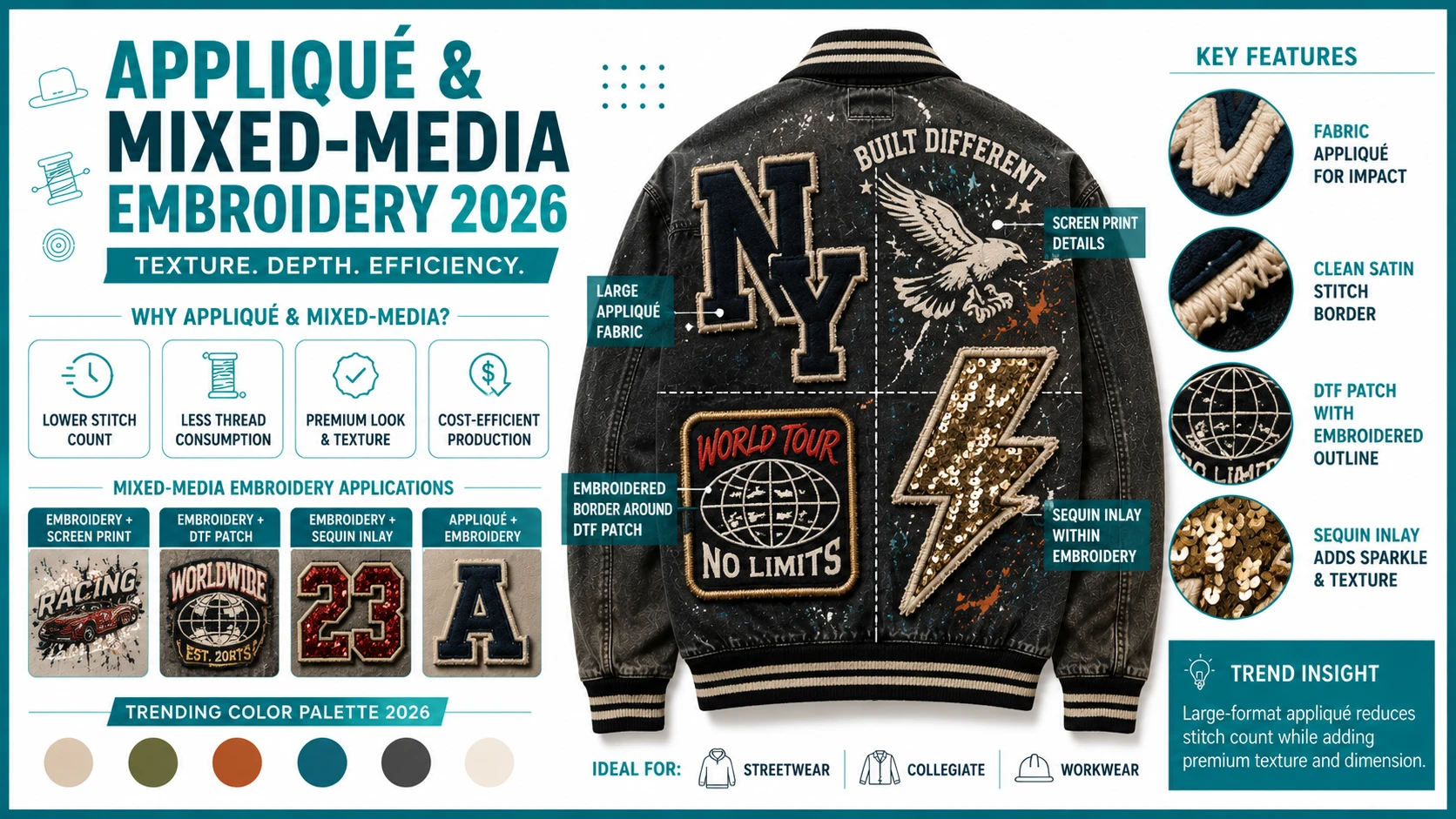
Appliqué — fabric cut to shape and stitched onto a base — is trending as brands seek large-format designs that are both visually impactful and cost-efficient to produce.
A full back panel in solid satin-stitch fill carries a high stitch count. The same visual footprint achieved with a shaped appliqué fabric and a clean satin-stitch border runs faster, uses less thread, and often looks more premium because the fabric insert adds texture variation flat stitching cannot replicate.
In 2026, the mixed-media approach extends further: embroidery combined with screen printing, embroidered borders around DTF-printed patches, and sequin inlays within embroidered frames are all appearing across branded collegiate, streetwear, and workwear categories. TrueDigitizing offers appliqué embroidery digitizing for simple cut shapes through complex multi-layer designs with blended fill and appliqué zones.
Wilcom EmbroideryStudio 2026 — the most widely used professional digitizing software in commercial production — introduced dedicated tools for several of the stitch types below this year, including a Multi Blend tool for layered gradient stitching and Redwork Automation for converting outlines into optimized continuous-path runs. The software's new Wilcom Answers AI assistant provides in-software guidance sourced from official Wilcom documentation.
| # | Stitch Type | Primary 2026 Application |
|---|---|---|
| 1 | Running stitch | Minimalist line art, outlines, single-thread designs |
| 2 | Satin stitch | Lettering, logos, bold shapes under ~12mm width |
| 3 | Fill stitch (tatami) | Large-area coverage in floral panels and backgrounds |
| 4 | 3D puff stitch | Raised logos, hat embroidery, bold letterforms |
| 5 | Stem stitch | Botanical outlines, script text, curved paths |
| 6 | Appliqué stitch | Fabric tack-down and border stitching for inlay designs |
| 7 | Gradient fill | Ombre florals and color-shift effects using blended layers |
| 8 | Redwork | Continuous outline designs with no fill; trending in vintage and line-art styles |
| 9 | Cross stitch | Heritage, folk, and nostalgia-driven applications |
| 10 | Underlay stitch | Foundation layer — invisible in finished work, determines surface quality for everything above it |
Placement strategy has become as deliberate as the design itself — a pattern Printful's 2026 trend research explicitly identifies as one of the defining shifts in branded apparel this year.
| Placement | 2026 Application | Style Match |
|---|---|---|
| Left chest | Corporate uniforms, formal branded polos | Traditional — still dominant in formal contexts |
| Right chest | Differentiated branded casualwear | Intentionally asymmetric, modern feel |
| Upper sleeve / arm | Streetwear, athletic, team apparel | Bold lettering, numbers, club marks |
| Back of collar | Luxury brands, hotel and hospitality | Micro logo, tone-on-tone thread |
| Cuff / wrist | Premium dress shirts, bespoke | Initials, small motif, date |
| Full jacket back | Statement fashion pieces | Oversized floral, large-scale typography |
| Hip (jogger side) | Athleisure and activewear | Small logo, vertical text placement |
| Side seam | Fashion-forward labels | Vertical typographic text |
| Inside collar / hem | Premium branded programs | Micro "discovery" details |
Ready to digitize your 2026 trend design? Whether it's 3D puff, minimalist line art, or an oversized floral panel — TrueDigitizing delivers production-ready stitch files in 24 hours or less.
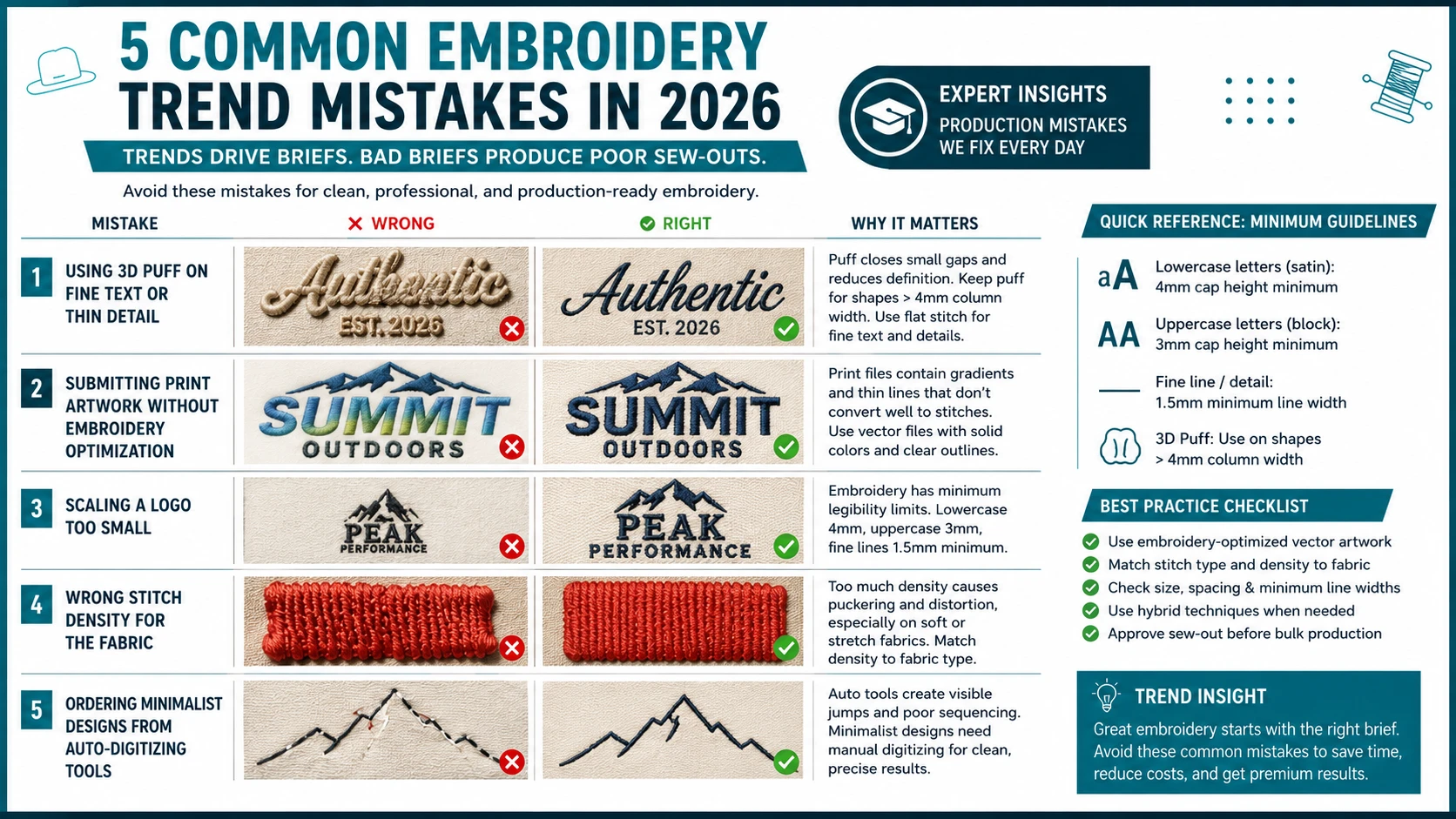
Start My OrderTrends drive briefs. Bad briefs produce poor sew-outs. These are the five mistakes we see most frequently when brands chase 2026 trends without accounting for how embroidery actually works.
Whether it's a minimalist botanical, a 3D puff logo for hats, an oversized floral, or a mixed-media appliqué design — TrueDigitizing delivers a production-ready stitch file in 24 hours.
Upload Your Design →Free quote · No setup fee · Unlimited revisions · 24-hour turnaround
TrueDigitizing's team of embroidery digitizers and file conversion experts — delivering practical guides for home hobbyists and commercial shops alike. Our specialists cover the full range of embroidery production: custom digitizing for machine embroidery, vector art conversion, and physical embroidered patch manufacturing — with a 6-hour turnaround on digital files and worldwide patch delivery in 5 business days. Every article we publish comes from the same people handling real production orders daily. When we write about stitch density, underlay settings, or file formats, it is because we work with these variables across hundreds of client files every week — not because we researched them from the outside.
Categories
Embroidery Digitizing Services: Which Type Do You Need?
17-08-2026
How to Remove Embroidery From Any Fabric — Step-by-Step Guide 2026
15-07-2026
Is SVG a Vector File? Yes — SVG vs EPS, PNG, PDF Vector Formats you need to know
08-07-2026
Top Best Embroidery Digitizing Software in 2026
06-05-2026
Best Multi-Needle Embroidery Machines for Startups 2026
28-02-2026
DST File: The Complete Guide (What It Is, How to Create, Convert & Use in 2026)
28-02-2026
Janome 550E vs Baby Lock Flare | Best Mid-Range Embroidery Machine?
26-02-2026
Choose the Right Fabric for Embroidery
20-02-2026

Advanced Techniques in Embroidery Digitizing
19-02-2026

Most Common Types of Threads to Use in Machine Embroidery
12-02-2026
Asked Questions